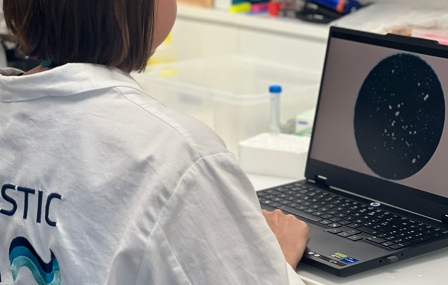
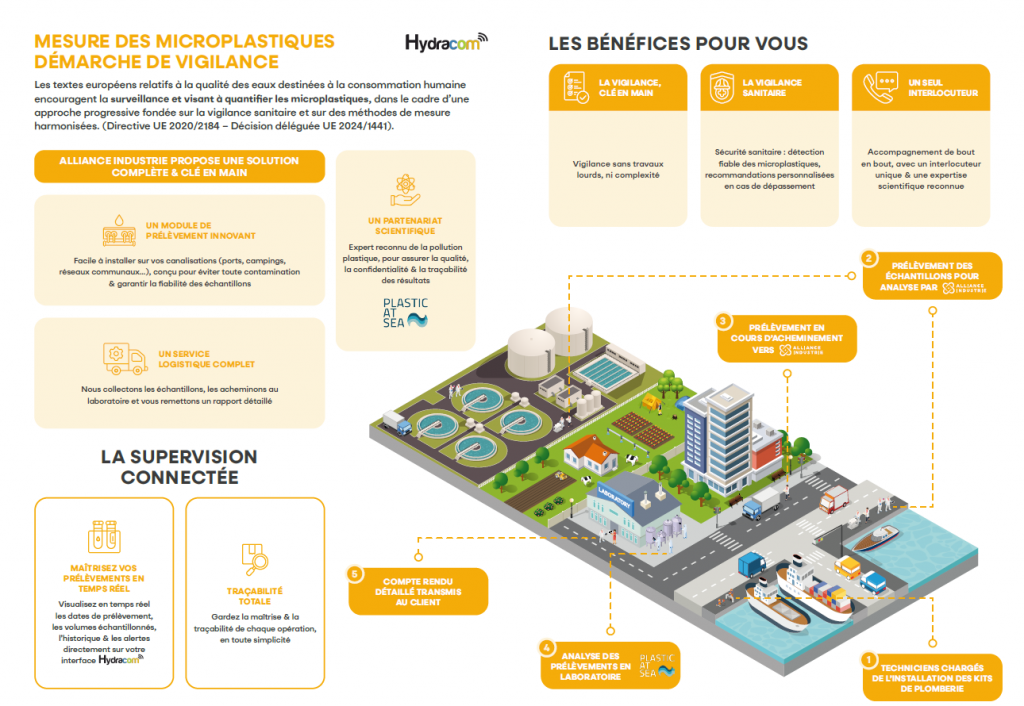
Plastic at Sea offers a comprehensive service for the quantification, identification, and characterization of microplastics, applicable to various matrices to meet regulatory requirements and industrial needs:
STEP 1: INITIAL CONTACT
Before providing you with a price quote, we take the time to analyze your sample and your needs. This step allows us to ensure that our service is perfectly tailored to your needs and that our microplastic test results are completely reliable.
STEP 2: SHIPPING YOUR SAMPLE
Following our initial discussion, please send your initial sample to our laboratory so that we can begin processing it
STEP 3: ANALYSIS
Sample preparation, automated LDIR analysis, quality assurance, and data processing.
STEP 4: DATA AND REPORT
Our services include comprehensive data standardization and presentation. Scroll down to learn more about our data and the process behind it.
OUR STATE-OF-THE-ART TECHNOLOGY
Laser Direct Infrared (LDIR) Imaging is a device used for the infrared identification and semi-quantification of microparticles—including microplastics, fibers, and other particles—as small as 1 µm.
Its direct infrared laser chemical imaging system enables rapid analysis.
Microplastics measure less than 5 mm. It is often the smaller particles—those measuring less than 100 microns (µm)—that attract the most attention, as they are invisible to the naked eye and can enter the food chain.
The LDIR is the only instrument recognized as an analytical technique in the standards for quantifying microplastics in drinking water (in accordance with European Directive 98/83/EC on the quality of water intended for human consumption (EDCH)).
It can also analyze the presence of microplastics in soil, in the air, and in food.
You will receive the IR spectrum and identification of your microparticles, allowing for a comparison with the MicroMatrix database (owned by Plastic at Sea), which catalogs the various quantities and qualities of microplastics along the major land-to-sea continuums in Europe.
ISO/TC 147/SC 2/JWG 1 standard in progress
XP T 90-968-1 vibrational spectroscopy.
To learn more about our quantification services, click this link.
WHY MEASURE MICROPLASTICS?
Measuring microplastics has become a key issue for local governments, manufacturers, and all organizations committed to environmental sustainability.
First and foremost, it enables us to meet current regulatory requirements and anticipate future ones, particularly in the area of water quality.
By precisely quantifying the particles present in a sample, it becomes possible to verify the compliance of a site, product, or process, while also providing reliable indicators for implementing a pollution reduction strategy.
Microplastic analysis also provides a better understanding of products and how they behave over time. It makes it possible to assess the potential migration of particles from a container into its contents—a major concern for the food, cosmetics, and industrial sectors.
This in-depth knowledge helps optimize manufacturing processes and reduce emissions at the source.
From an environmental perspective, quantifying microplastics is an essential tool for measuring the actual impact of an activity or a region.
It makes it possible to evaluate the effectiveness of treatment or filtration systems, in particular by measuring their removal efficiency.
This data is essential for initiating or strengthening an environmental transition process, guiding investments, and implementing appropriate corrective measures.
A PARTNERSHIP-BASED APPROACH
Head of the Quantification Division
Edouard Lavergne
Ph.D. in marine biology specializing in plastic quantification